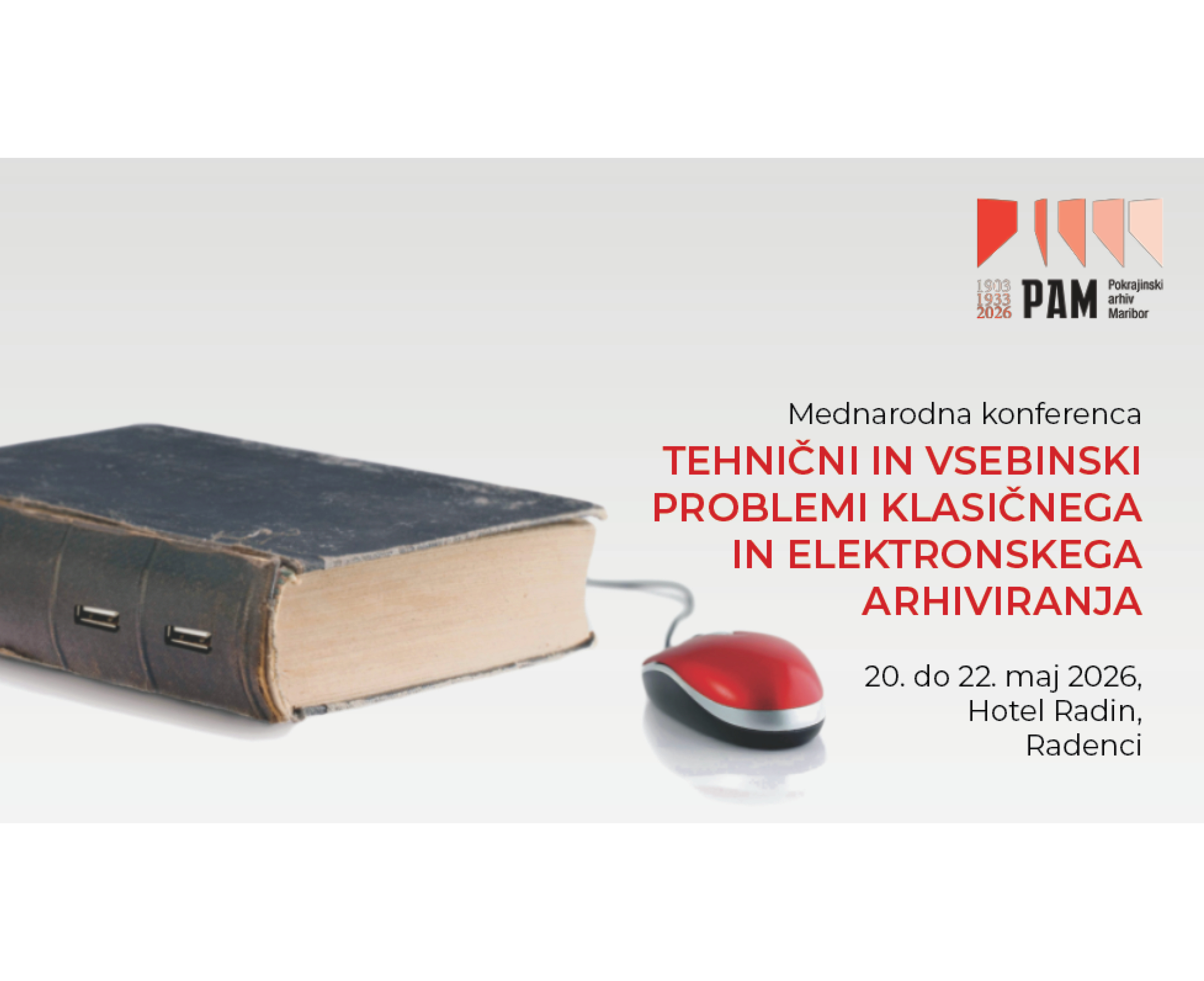
International Scientific Conference
TECHNICAL AND FIELD RELATED PROBLEMS OF CLASSICAL AND ELECTRONIC ARCHIVING
20–22 May 2026
Hotel Radin, Radenci, Slovenia
The Regional Archives Maribor will again organize an international conference in 2026, bringing together experts in archival science, documentation, records management, and all professionals engaged in archival and records management who wish to follow developments in this scientific and professional field. Each year, the conference presents new insights into the theoretical foundations of archival science and documentation, professional procedures, research, standards, guidelines, best practices, projects, and programmes.
The three-day international conference brings together professionals, researchers, and practitioners from the fields of archival science, information science, history, and records management. Through lectures and discussions, participants will address key challenges facing the archival profession in the era of digital transformation. The conference programme explores topics such as artificial intelligence, digital preservation, legislation, information accessibility, and the social role of archives as custodians of collective memory.
This year’s programme features engaging presentations by domestic and international experts intended for archival professionals as well as employees working with records creators. Below we present the confirmed speakers and contributions; the programme is still being updated.
Conference registration will open on 6 April 2026.
Programme and registration
Registration Fee
Conference participation fees (VAT excluded):
EUR 380 – three-day participation
EUR 180 – one-day participation
The fee includes participation in the professional programme, the book of abstracts and other conference materials, lunch on Wednesday, dinner on Thursday, professional excursion (subject to availability), refreshments during breaks, and hospitality during the social/professional programme.
Information
Mojca Horvat
Tel.: +386 (0)2 228 50 19
E-mail: mojca.horvat@pokarh-mb.si
Mojca Kosi
Tel.: +386 (0)2 228 50 22
E-mail: mojca.kosi@pokarh-mb.si
Hotel Accommodation
A contingent of rooms has been reserved for conference participants at the hotel at a special rate. Rooms are available until 20 April 2026 or until capacity is filled.
Room reservations can be made via the link below:
Preliminary programme
Day One of the Conference
The first day of the conference will be devoted to reflecting on one of the key questions of contemporary archival science: how archives are responding to digital transformation, artificial intelligence, and new forms of cultural memory. Speakers from Slovenia and abroad will present current research, practical case studies, and challenges shaping the future of the archival profession.
- The conference will be opened by dr. Mladen Borovič (Faculty of Electrical Engineering, Computer Science and Informatics, University of Maribor) and Dr. David Hazemali (Faculty of Arts, University of Maribor) with the interdisciplinary paper From Archival Dust to Algorithm: Genealogy in the Grip of Artificial Intelligence, exploring how artificial intelligence is transforming genealogy and raising new questions about the interpretation of historical sources.
- The issue of long-term preservation of digital heritage will be addressed by Dr. Wolfram Dornik (Graz Municipal Archives, Austria), who will present the role of archives in preventing a “digital dark age” and emphasize the importance of systematic preservation of community digital data.
- Digital community collaboration will be highlighted by Dr. Julius Goldman (Municipal and Abbey Archives Aschaffenburg, Germany), who will present the Heimat:data project, a participatory platform for collecting and preserving private and community collections in Bavaria.
- The practical aspects of digital archiving will be presented by Anouk Marie Stephano (Vienna City and Provincial Archives, Austria), who will demonstrate—through the experience of the Vienna archives—why effective records management forms the foundation of successful archiving.
- The use of artificial intelligence in everyday archival practice will be discussed by Martina Arhar Fekonja (Historical Archives Ljubljana), who will analyse the potential use of the ChatGPT language model as a support tool for archivists, while Igor Filipič (Archdiocesan Archives Maribor) will explore communication patterns between users and AI conversational assistants.
- An international perspective on the application of artificial intelligence will be provided by M.Sc. Siniša Domazet (Archives of Bosnia and Herzegovina), presenting the use of AI tools in the Archives of Bosnia and Herzegovina and their potential for opening access to historical sources.
- Special attention to digital heritage will also be given by Dr. Christine Rigler (University Archives of the University of Graz, Austria), who will discuss email as an important yet problematic component of cultural heritage.
- Contemporary concepts of archiving born-digital records will be presented by Dr. Arian Rajh, Dr. Hrvoje Stančić, and Jelena Bolkovac (Faculty of Humanities and Social Sciences, University of Zagreb, Croatia), while M.Sc. Martin Rechtorik (Czech State Archives, Prague, Czech Republic) will address the appraisal of geospatial data within hybrid archival files.
- Community-based memory preservation practices will be introduced by M.Sc. Adriana Kapala (Community Archives Center, Toruń, Poland), focusing on oral history collections in Poland and the challenges of a bottom-up approach.
- Aleksander Lavrenčič (RTV Slovenia) will present the project Mura: Archival Material as Memory for the Future, which highlights industrial heritage and collective memory through archival sources.
- Colleagues from the companies Mikrografija d.o.o., Trevis d.o.o. and Tripont will present the latest trends in electronic and traditional archival storage.
The first conference day will thus provide a comprehensive overview of contemporary approaches to archiving—from artificial intelligence and digital preservation to participatory practices and archives in emergency contexts—while opening space for discussion on the future of archival science in the digital society.
Day Two of the Conference
The second day of the conference will focus on methodological, legislative, and infrastructural aspects of archival activity, with particular emphasis on archival description, heritage protection, digitisation, and the role of archives in contemporary society and the public sphere.
- The day will open with Dr. Bogdan-Florin Popovici (Romanian National Archives, Brașov, Romania), who will present current challenges in applying the conceptual model Records in Contexts (RiC) in the paper And Yet… How Do We Describe Records Using RiC?, encouraging reflection on the future of archival description.
- Issues of accessibility of digitised archival materials will be addressed by Dr. Zdenka Semlič Rajh (Archives of the Republic of Slovenia), discussing the dilemma between digitisation and actual online accessibility of archival records.
- The impact of climate change on archival work will be addressed by M.Sc. Katja Almberger (Carinthian Provincial Archives, Klagenfurt, Austria), presenting concrete measures for protecting archival materials in the Alpine-Adriatic region and the experience of the Carinthian Provincial Archives.
- Spatial and infrastructural challenges faced by archives will be discussed by Dr. Maria Alexandra Sas through a comparative study of archival buildings in Slovenia, opening the dilemma between adapting existing structures and constructing purpose-built archival facilities.
- The legislative framework of archiving will be examined by M.Sc. Marijana Todorović Bilić (Archives of Republika Srpska, Banja Luka, Bosnia and Herzegovina), presenting the legal status of public records and archival materials of private legal entities within the legislation of Republika Srpska.
- The digital presentation of sensitive historical heritage will be explored by Dr. Julija Barunčić Pletikosić and Dr. Željka Križe (Croatian Memorial Documentation Center of the Homeland War, Zagreb, Croatia), analysing online presentations of archival material on the Croatian Homeland War in archives and museums.
- The importance of public visibility of archives will be addressed by M.Sc. Jasmin Jajčević (Archives of Tuzla Canton, Bosnia and Herzegovina), presenting the role of media and social networks in promoting archival activities in Bosnia and Herzegovina.
- Digitisation as a key preservation strategy will be presented by Darko Marinković (Military Archive, Ministry of Defence of the Republic of Serbia, Belgrade, Serbia), who will showcase the development and operation of the IDA 2.0 information system in the Serbian Military Archive.
- The technological dimension of modern archiving will continue with Saša Đukić (Archives of Republika Srpska, Banja Luka, Bosnia and Herzegovina), presenting possibilities of free software solutions for e-archiving and paperless administration, while Dušan Guteša and Suzana Milenković (Military Archive, Ministry of Defence of the Republic of Serbia, Belgrade, Serbia) will discuss classification of archival and documentary materials in the context of changes in categorisation within the defence system.
- Historical sources and their research value will form the focus of the final session. M.Sc. Mitja Sadek (Historical Archives Ljubljana) and Branka Molnar (Center for Restructuring and Sale, Zagreb, Croatia) will present the chronicle of the Novo Mesto Capuchin Monastery as an important archival and scholarly source; Dr. Fuad Ohranović (Historical Archives Sarajevo, Bosnia and Herzegovina) will examine documents of the Archives of Bosnia and Herzegovina as historical sources from the Middle Ages to the modern era; and M.Sc. Amel Redžić and Sadika Maslak (Archives of Una-Sana Canton, Bihać, Bosnia and Herzegovina) will present administrative records between the two World Wars as valuable testimonies of the past.
- A unique perspective on archival work in crisis situations will be presented by Dr. Volodymyr Mikhalko and Lyudmila Didukh (Ukrainian Research Institute of Archival Affairs and Records Management, Kyiv, Ukraine), who will discuss the preservation of digital archival documents during active military operations in Ukraine.
- Two workshops dedicated to the archiving of born-digital records are also planned and will be conducted by the Archives of the Republic of Slovenia.
The second conference day will thus highlight the diversity of archival science—from descriptive theory and legislation to digital solutions, preservation practices, and interpretation of historical sources—demonstrating how archives remain key mediators between the past, present, and future.
In the afternoon, participants will refresh their minds and continue professional discussions during a study excursion to Razkrižje.
Day Three of the Conference
The third day of the conference will be devoted to legal, organisational, and security aspects of records and archival management, with emphasis on open science, information security, and legislative frameworks shaping contemporary archival practice.
- The day will open with Sanja Gerdak (Mariborski vodovod d.o.o.), presenting the process of revising internal regulations within the company and highlighting the importance of systematic records management in business organisations.
- The role of data archives in the contemporary research environment will be presented by Sonja Bezjak (Social Science Data Archives, Ljubljana), who will discuss the contribution of the Social Science Data Archives to the implementation of open science principles and to ensuring accessibility and reuse of research data.
- Participants will then be introduced to information security by Dr. Benjamin Lesjak (Datainfo d.o.o.), who will present key challenges of protecting information systems and data in everyday working environments through practical examples.
- Legal aspects of archival protection will be addressed by M.Sc. Aida Škoro Babić (Archives of the Republic of Slovenia), presenting the protection of archival material in both digital and physical form within the context of relevant legislation, with special emphasis on judicial records.
- The conference programme will conclude with Dr. Gregor Škafar (Archdiocesan Archives Maribor), who will present archival legislation and regulations concerning parish registers in Slovenia and neighbouring countries, highlighting possibilities and methods of access to this exceptionally important historical source.
The third conference day will therefore emphasise the importance of clear rules, security, and accessibility in records management, demonstrating that contemporary archival science—alongside technological innovation—also requires strong legal and organisational foundations.
We believe that the topics addressed will contribute to deepening knowledge across many fields and help resolve challenges faced by records creators as well as archival professionals.